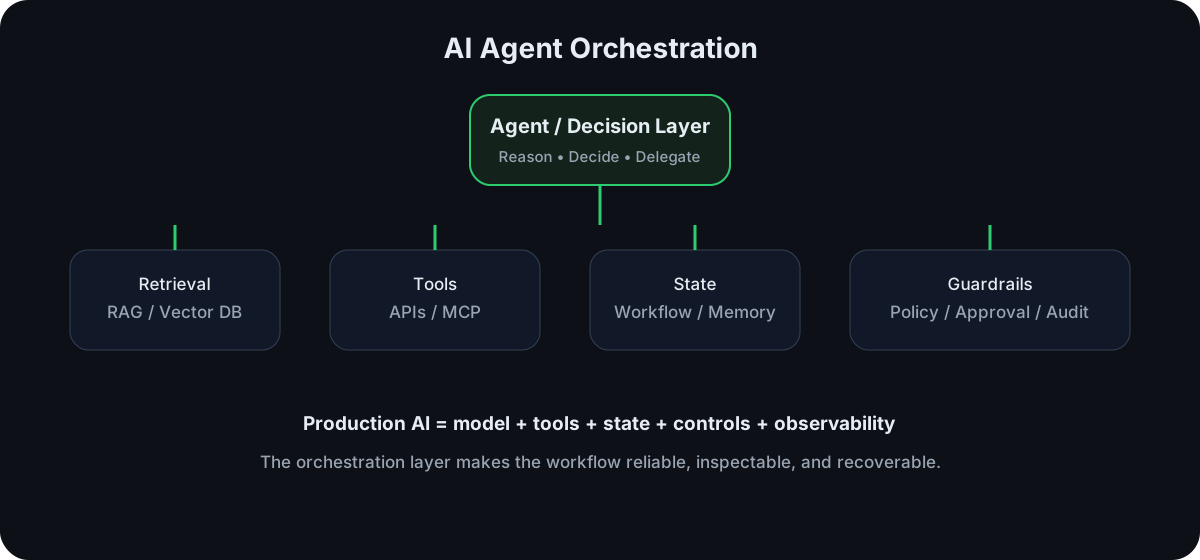
As AI moves from “answer a question” to “take an action”, the engineering problem changes. An agent might read customer data, call internal APIs, create records, send messages, or trigger financial operations.
That is where I think AI governance becomes an engineering concern, not only a policy concern.
Start With What the Agent Can Actually Do
The first useful question is simple: What actions can this agent perform?
For every tool, I want a clear contract around its purpose, input, output, authorization, and risk. A read-only search tool should not have the same permissions as a tool that changes production data.
search_customer   → read-only
get_order         → read-only
cancel_order      → write / approval required
issue_refund      → high-impact / approval required
Put Controls Around Tools
A model can recommend an action, but the backend should enforce whether that action is allowed.
decision = agent.plan(request)

if policy.allows(user, decision.tool, decision.input):
    execute(decision.tool, decision.input)
else:
    requestHumanApproval(decision)
This separation is important. The prompt can explain policy, but the application should enforce policy.
Keep an Audit Trail
For production systems, I want to answer questions such as: Which model made the decision? Which tools were called? Which user initiated the workflow? What data was accessed? Was approval required? What was the final outcome?
A useful audit record might look like:
{
  "workflowId": "wf_123",
  "actor": "user_456",
  "tool": "issue_refund",
  "risk": "high",
  "approval": "required",
  "status": "completed"
}
Evaluate the Workflow, Not Only the Model
Traditional model evaluation is not enough for an agent that can take actions. I also want to evaluate tool selection, argument correctness, policy violations, retrieval quality, unnecessary tool calls, latency, and recovery after failures.
For example, a workflow test can ask:
- Did the agent choose the correct tool?
- Did it respect authorization?
- Did it request approval for a high-impact action?
- Did it avoid exposing restricted data?
- Did it recover safely after a timeout?
Use a Risk-Based Approach
Not every AI interaction needs the same level of control. A documentation assistant and a financial workflow have very different consequences.
I prefer to classify tools and workflows by impact, then increase controls for higher-risk operations: stronger authorization, human approval, richer audit logs, additional evaluation, and tighter monitoring.
Where Standards Fit
NIST's AI Risk Management Framework describes four core functions — Govern, Map, Measure, and Manage — and treats governance as a cross-cutting function throughout the AI lifecycle. The framework is voluntary, so I treat it as a useful structure for thinking about controls rather than a one-size-fits-all implementation. NIST AI RMF
My Practical Takeaway
AI governance becomes much more useful when it is translated into engineering controls: explicit tool permissions, policy checks, audit trails, evaluation, approval workflows, data boundaries, and continuous monitoring.
The goal is not to slow an agent down. The goal is to make the system predictable enough that teams can understand what it can do, what it actually did, and where humans remain in control.