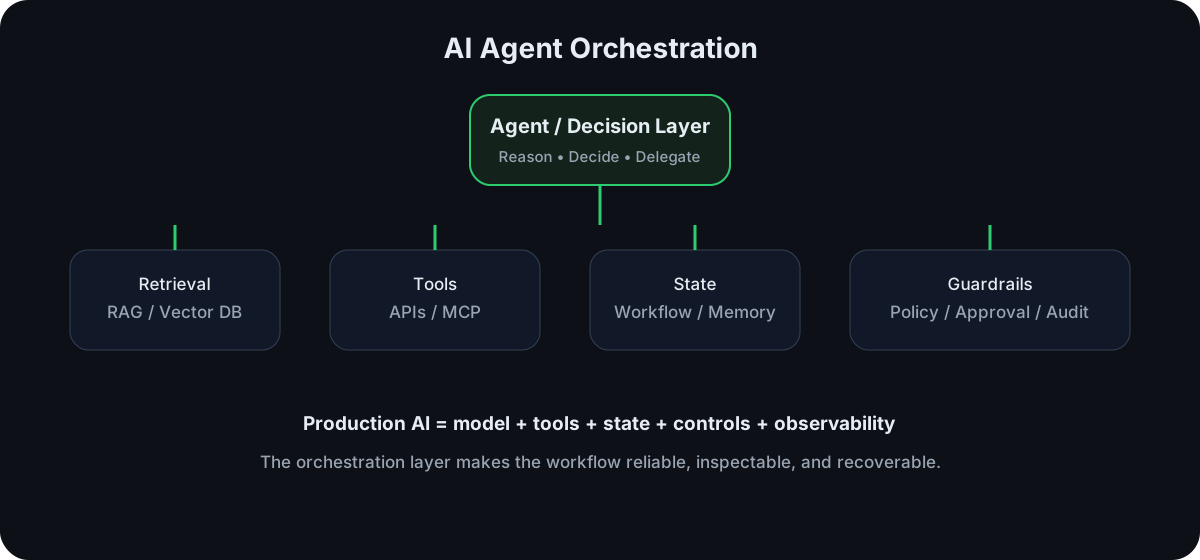
One of the biggest things I am learning while building AI-enabled applications is that the model is only one part of the system.
The real engineering work starts when an AI workflow needs to retrieve information, call an API, update a database, ask for approval, retry a failed operation, and continue from the correct state.
The AI Application Is a Workflow
A useful mental model is:
User
  ↓
Agent / Decision Layer
  ├── Retrieval
  ├── Tool/API calls
  ├── Database
  └── Human approval
  ↓
Response / Action
The orchestration layer decides which step happens next, what data is passed between steps, and what should happen when a step fails.
Give Tools Narrow Responsibilities
Instead of exposing one powerful function such as runAnything(), I prefer small tools with explicit contracts.
get_customer()
search_orders()
create_refund()
send_notification()
This makes permissions, testing, logging, and failure handling easier. It also gives the agent fewer ambiguous choices.
Retries Need Idempotency
Imagine an agent calls a payment API and the network connection drops immediately after the provider accepts the payment. Retrying blindly could create a duplicate transaction.
A safer pattern is to attach an idempotency key to the business operation:
const key = "refund:" + orderId + ":" + requestId;

await paymentProvider.refund({
  orderId,
  idempotencyKey: key
});
The same logical operation can then be retried without treating every retry as a new business action.
State Becomes Important in Multi-Step Workflows
A single prompt can be stateless. A production workflow usually cannot.
If the workflow is retrieve → validate → call API → wait → verify → notify, the system needs to know which steps are complete. Persisting workflow state also makes recovery possible after a process restart.
Observability Is Not Optional
For AI workflows, I want to understand more than the final answer. Useful signals include:
- Which tools were called?
- How long did each step take?
- Where did the workflow fail?
- What retrieval operation was performed?
- How many model calls were required?
- Which workflows required human intervention?
Logs should still be designed carefully so sensitive prompts, credentials, and customer data are not accidentally exposed.
Keep Business Rules Outside the Prompt
Prompts are useful for reasoning and natural-language interaction, but important business rules should remain enforceable in application code.
For example, an agent may decide that a refund should be created, but the backend should still enforce the actual refund limit, authorization, order state, and audit requirements.
My Practical Takeaway
I increasingly think about AI applications as distributed software systems with an intelligence component. The model can make decisions, but reliable orchestration makes those decisions safe and useful in production.
Clear tools, explicit state, idempotent operations, bounded retries, strong observability, and application-level business rules are what turn an AI demo into an engineering system.